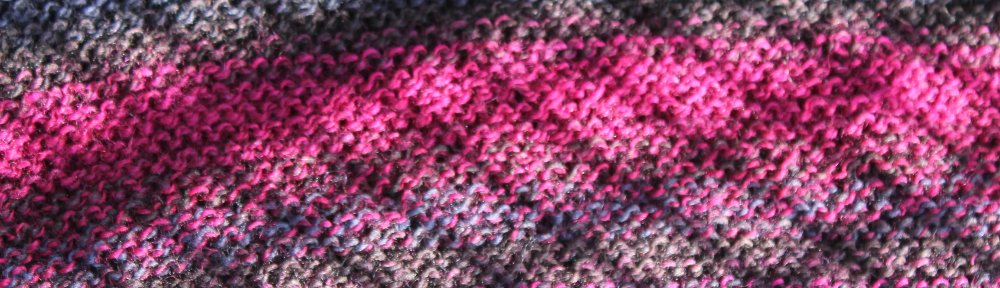
 Wie schon gesagt, einfach nur die Toile de Jouy oben an den Strickstoff ansetzen… ist mir zu langweilig. Und paßt einfach nicht ganz. Da fehlt was. Zu hell? Zu wenig Struktur? Egal, einfach so ist es einfach zu platt.
Da sah ich irgendwo beim Surfen (leider weiß ich nicht mehr wo) ein Kissen in Chenilletechnik. Was mir gefiel war, daß man das Muster der untersten Stofflage irgendwie noch erkennen konnte. Und für Struktur sorgen die plüschigen Raupen auch.
Eine prima Idee, den gewonnen Chenilleschneider einmal einzusetzen.
As I’ve said before… just sewing the Toile de Jouy to the knit doesn’t work for me. Is it to light in colour? Is it the structure that doesn’t match? No matter… it doesn’t work.
But some time ago, surfing the web (I don’t remember where) I saw a cushion in Chenille. What I liked about that model was, that the lowest fabric was a print and you could still figure out, that it was a flower print. No details, but the idea was still there. Plus the Chenille creates texture…
So I decided to try my newly won Chenille-Cutter.
Manchmal werde ich gefragt, woher ich denn immer vorher weiß, was hinterher rauskommt.
Die Antwort ist einfach: Ich weiß es nicht, ich probiere es.
Da ich von den Challenge-Stoffen nicht viel habe, teste ich die Idee zuerst einmal mit einem Rest eines alten Blumendruckes. (War mal ein Sonderangeobt und ich hatte sehr viel davon. Ein Schlafanzug für mich und ein Kleid für eine liebe kleine Verwandte waren damals entstanden.) Obendrauf kommen zwei Lagen des blauen Köper vom Proberock.
Zuerst lerne ich, daß es gar nicht so einfach ist, richtig mit dem Chenilleschneider umzugehen und dann lerne ich, daß die unterste Stofflage etwas größer sein sollte, damit man den Einstieg besser findet.
Ich versuche die schmalste und die breiteste Einstellung, die der Schneider hergibt. Nach zwei Runden in der Waschmaschine ist es noch nicht perfekt, aber die Richtung stimmt so grob. Es wird plüschig und die Abstände zwischen den Steppreihen sollten nicht zu klein sein. Dann könnte es klappen…
 Sometimes people ask me, how I know in advance what will be the outcome of my experiments. Well, the answer is easy: I don’t know, I just try…
The amount of fabric from the Challenge is somewhat limited, so I’m using the restover of an old flower print (bought very long ago at a sale and made into pyjamas for me and a cute dress for a little girl in my family) as basis and two layers of the blue fabric of my test-skirt.
First thing I learn is, that using this tool corectly takes a little more experience than expected. (Not much, but I had expected it to work with „no experience at all“). Second thing I learn is that the lowest layer of fabric shold be a little bigger than the other, to make it easier to insert the cutter in the tunnels.
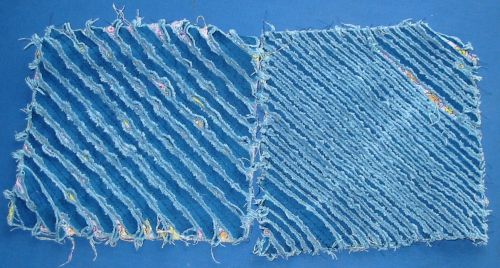
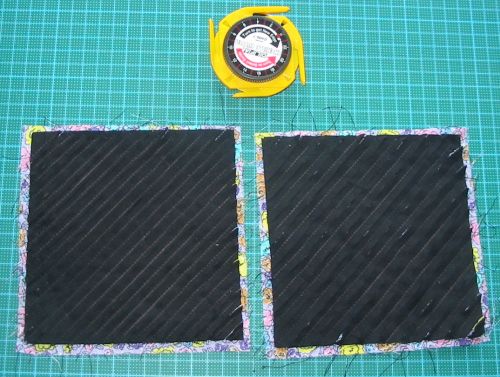
I make to samples, one in the smalles variation, the other in the largest. The first picture shows the scraps after running through the washing machine twice. Not perfect yet, I cannot see enough of the basic fabric, but if the other fabric ravels a little more… it should do.
Doch jeder Stoff verhält sich anders, also die nächste Testrunde mit dem schwarzen Silicon popelin, der auch auf das engültige Kleidungsstück drauf soll.
Der Umgang mit den Chenilleschneider klappt schon viel besser.
Diesmals wähle ich die beiden mittleren Tunnelgrößen. 1cm und 0,7 cm.
 But every fabric is different.
So next try, again with the flower print as basic layer but on top the black „Silicon Popelin“ I intend to use for the Challenge garment.
This time I’m choosing the two „middle“ sizes of the cutter: 1cm and 0,7cm for the tunnels.
And cutting goes much quicker now… the tool it easy to use…
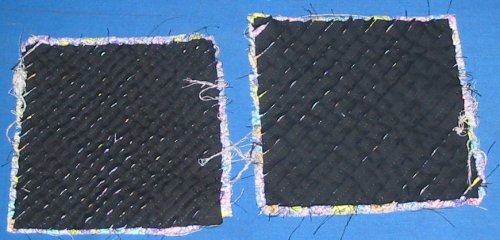
Nun, das untere Bild zeigt den Stoff nach zwei Runden in der Waschmaschine.
Und heftigem Bürsten mit dem Nagelbürstchen.
Kein großer Unterschied zu Bild 2?
Richtig. Der Stoff… franst gar nicht. Nicht nenneswert jedenfalls. Das war schon mal nix… ich brauche mal wieder einen Plan B. Und diesmal… hat mein Hirn noch keinen. Aber es brütet…
Well, the last picture shows the samples after having passed the washing machine twice. And heavy brushing with a strong brush.
Not much difference to picture two, you say? Yeah… the fabric doesn’t ravel. Or only very, very few.
So I’ll need another plan. I have no idea, what my brain will come up with. Neither has my brain… but we’ll see…