Warme Weihnachtskarten (Teil 1)

Weihnachtskarten aus süßem Weihnachtspapier oder aus putzigen Weihnachtsstoffen zu basteln bietet sich an, aber natürlich zu einfach. Ich möchte gerne meine Stoffreste verarbeiten und mit Hilfe des Filzaufsatzes der Nähmaschine (oder einer Filzmaschine, wie sie inzwischen etliche haben) geht das auch ganz einfach. (Nadelfilzen von Hand geht auch, dauert nur etwas länger).

Making your own christmas-cards from some of those cute themed papers or fabrics is tempting, but I try to avoid buying something new. I want to make them from scraps I already have. And the punching kit for my sewing machine (or an embellisher, if you have) makes that easy. (Needle felting by hand is also a possibility, takes just a little longer.)

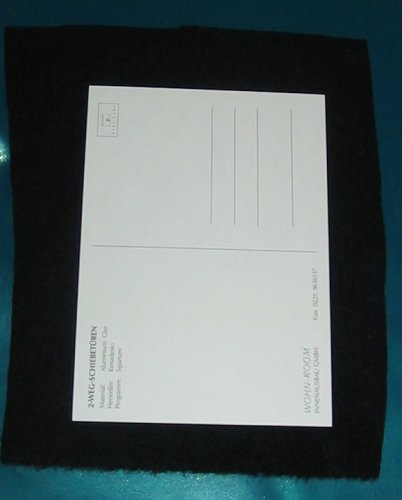
Postkarte

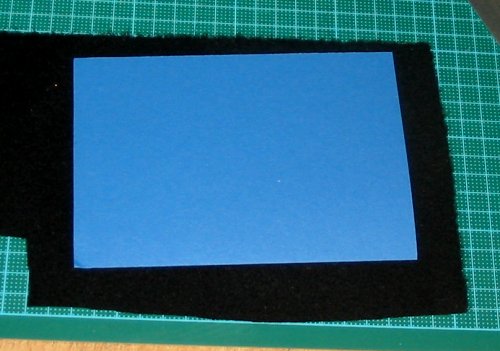
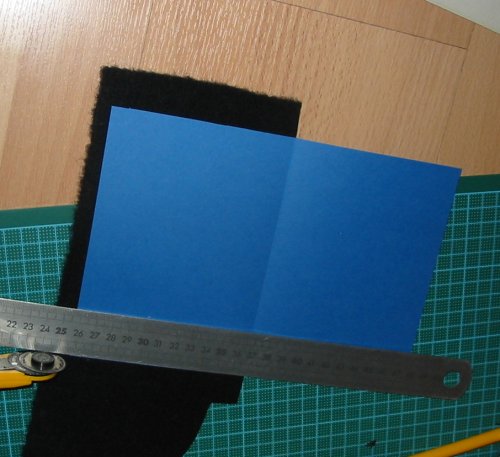
Ich schneide meinen Basisstoff (bei mir ist es Wollstoff von einem schwarzen Mantel, dichte Wollstoffe gehen am besten, natürlich auch Filz oder Loden) ein Stück größer als eine Postkarte zu. Dann lege ich eine handelsübliche Postkarte drauf und markiere die Umrisse. Auf meinem schwarzen Stoff nehme ich das kleine Kreiderädchen von Prym, aber da kann jeder seine Lieblingstechnik nehmen.

As a basic fabric I choose some woolen remenants from a cape. (Woolen coat fabrics are excellent for that purpose, boiled wool or Loden are fine, too.) I’m cutting a piece a bit bigger than a normal postcard, then I put a postcard on top and trace around. On the black fabric I used my chalk wheel from Prym, but you can use whatever technique you like.

Form zeichnen

Ich sagte schon, ich bin eine Zeichennull. Also schnappe ich mir meine Ausstechförmchen aus der Küche, hier einen Tannenbaum. (Ich habe auch Sterne gemacht)

Die Form sollte nicht zu klein und wenig detailreich sein. Der Ausstecher wird auf den Stoff gelegt, die Umrisse wieder mit weißer Kreide nachgefahren.

I think I mentionned it already, I’m such a looser when it comes to doing artwork, not even drawing simple objects. But I have my cookie cutters…

Here I used a tree shape. (I made also stars.) The motives shouldn’t be to small and they should not have may details. Therefore.. cookie cutters are just perfect. Just place the cookie cutter on your fabric and trace.

Filzen

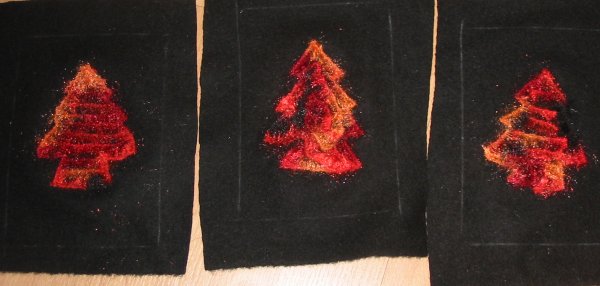
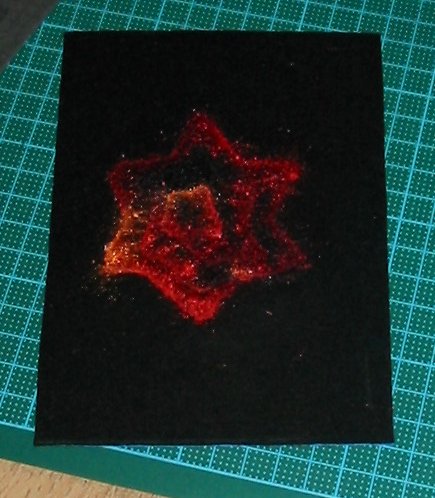
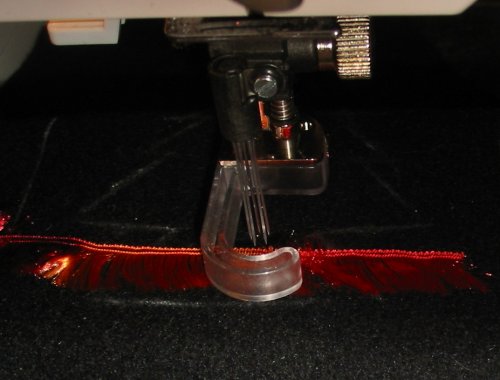
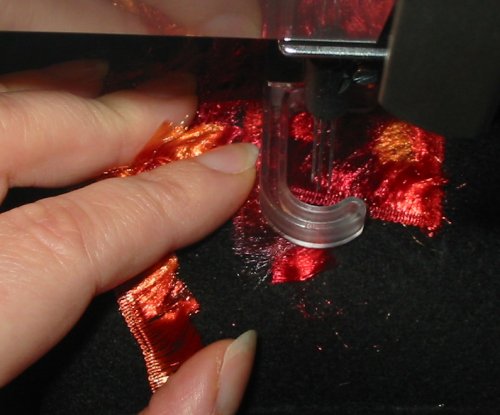
Dann lege ich meinen Basisstoff schon unter die Filzmaschine. Wollreste werden draufgelegt, ich entscheide mich für ein glänzendes orange-rotes Fransengarn aus Kunstfaser. Das Garn wird beim einfilzen ziemlich zerhackt und so haften auch die glatten Fasern gut im Basisstoff. Dickes, wenig gedrehtes Strickgarn ist ansonsten eine gute Wahl. Oder Märchenwolle, wenn man hat.Ich lege immer ein Stück Garn, filze das fest, lege wieder ein Stück Garn, filze das weider fest,… abgeschnitten wird der Faden immer erst wenn er festgefilzt ist, damit man ihn gut festhalten kann ohne die Finger zu nah an die Nadeln zu bringen.

Am Ende umdrehen und von der linken Seite noch mal drüberfilzen, damit es besser hält. Ich filze noch ein weiteres Mal von rechts, damit die Farben meines Garnes wieder besser rauskommen.

Je nach dem ob man sein Motiv quasi „Reihenweise“ ausfüllt oder der Kontur folgt ergeben sich andere Effekte. Nichts davon ist falsch, man nimmt was einem besser gefällt oder wenn man sich (wie ich) nicht entscheiden kann macht man es mal so und mal so.

Filzen

Then you start felting. I*ve used some shiny polysomething knitting yarn with fringes. They work well into the fabric. Chunky yarns are another good choice. Or special strands of material for needle felting.

I put a bit of yarn inside the shape of my motive and start felting. I move the yarn to the next centimeters and felt again… and so on. If I have to cut the yarn I do it after it is felted, so I always have a tail long enough to hold and guide it, my fingers safely away from the sharp needles. You can lay the yarn in rows, randomly, following the outlines… whatever you want. Nothing is „right“ or „wrong“, it’ll look always different and you go as you like.

When everything is well attached and the shape is filled I turn it around and felt it shortely from the left side, to make it stick better into the fabric. Then I turn again and felt from the right side, do make the yolours of the yarn come out better, again.

Aus dem Blogarchiv

Crafty posts from long ago

Dezember 2005:

Dezember 2006:


Rippen-oder-nicht Socken

Ribs-or-not socks

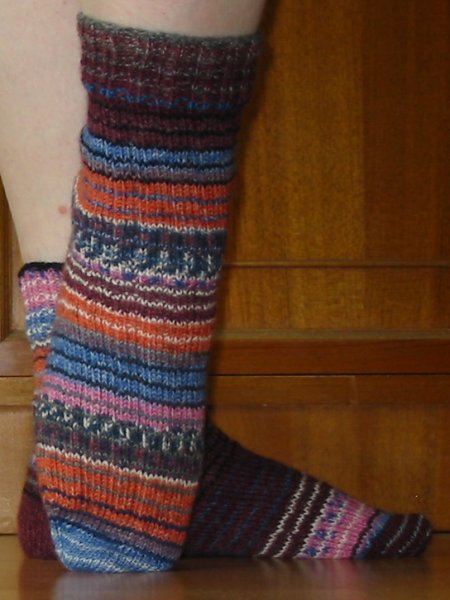
SockenSo, das sind die letzten Socken aus der Restekollektion

Auf den ersten Blick geringelt.

Auf den zweiten… haben sie irgendwie eine Längsstruktur. Rippen? Aber wie… ohne linke Maschen?

Those are the last socks from my restover socks collection.

Striped again.

On the second look… they have a kind of lengthwise structure, don’t they? Are there ribs? Without purling?

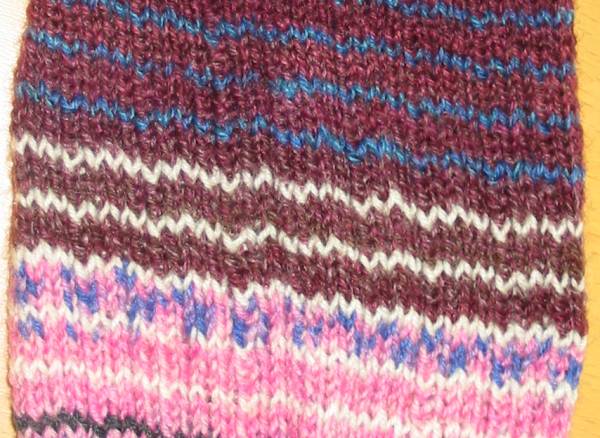
Socke, DetailDie Detailaufnahme verrät es dem Adlerauge.

Einige der rechten Maschen sind verschränkt gestrickt, auch das gibt feine Längsstreifen.

Das war es mit den Socken… in nächster Zeit stehen dann Lace-Schals auf dem Programm, aber das war ja schon zu sehen.

The detailshot may tell….

Some stitches wer knitted through the backloop, the result are very finde longtitudinal stripes.

Now that is all about socks for the next years I guess. Next will be Lace-shawls, but that you could already see.

Ripp-später-Socken

Rib-later-socks

Socken

Weiter geht es mit den Restesocken…

Rippen ermöglichen ja, daß die Socke sich dem Fuß gut anpasst. Dafür ist es flach bequemer.

Also fangen die Rippen hier erst irgendwo auf dem Fuß an und werden immer mehr, bis die Socke rundherum gerippt ist.

(Ganz einfach und es verhindert zu viel Langeweile beim Stricken…)

More socks…

The nice thing about ribbing on socks is, that the sock can adapt better to the shape of the foot. On the other hand plain is mor comfortable to the skin.

So here the ribs start somewhere on the middle of the foot and become more until they run all around.

(Easy, but prevents too much boredom while knitting… )

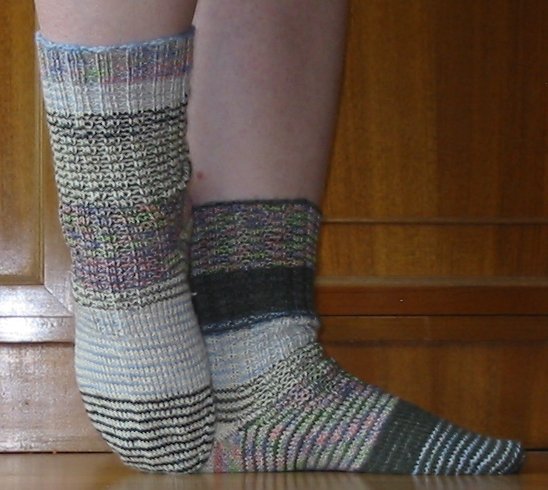
Cross the stripe-Socken

RestesockenUnd noch ein Sockenpaar aus der Resteverwertung. Diesmal waren es zwei größere Reste, einmal von den Space Invader Socken, die mein jüngster Bruder letztes Jahr zu Weihnachten bekommen hat und einmal die Regia Stretch von diesem luftigen Modell.

Und da mir nur Ringel natürlich zu langweilig waren, mußte auch noch etwas Struktur durch gekreuzte Maschen rein. Für Socken ist das Muster so nicht ganz optimal, wel es recht stabil und weniger dehnbar ist, aber für andere Zwecke werde ich es mir merken. Nämlich wenn ich mal wieder was suche, was formstabil bleiben soll…

(und jetzt zurück an die Lace-Borte. SissiL, vielen Dank für den Tip mit  den verkürzten Reihen. Ich habe zwar noch keine Vorstellung wie das mit dem Muster des Randes hinkommt, aber wenn ich mal etwas mehr Erfahrung mit Lace habe, dann wird das sicher auch noch werden. Ich merke es mir auf alle Fälle!)

Again „use up your sock yarn“ socks from the last weeks. I only needed two different yarns because what I had left was quite a lot. The cream yarn is from the Space Invader Socks my youngest brother got for Christmas last year, the blue is Regia Stretch from that airy pair.

And as plain stripes were to boring for me I added a bit of structure with crossed stitches. I have to admit that the pattern is not the best you can use for socks, because it takes out a lot of the stretch, but I will keep it in mind for other purposes. When I will be looking for something that keeps its form well.

(And now back to my lace border…)

Spitzenfrage

A Question of Lace

Wir unterbrechen die „Themenaufholjagd“ für eine aktuelle Frage… ich weiß, ich habe meine Socken noch nicht mal alle vorgezeigt, aber wie ich schon schrieb (glaube ich), meine Sockenwolle ist verstrickt und seit drei oder vier Wochen sitze ich an meinem erste Lace-Schal aus „Victorian Lace Today„. Einige Bahnverspätungen, ein paar Stunden im Wartezimmer… und auch die Randbordüre ist schon fast angestrickt. Damit allerdings habe ich ein Problem.

I know, I promised a lot of other posts which I have not done yet, but that’s an emergency… I haven’t shown all my socks yet but (I think) I wrote that I’ve used all my sockyarn and can therefor knit other things. For the last three or four weeks I have been knitting on my first lace scarf/ shawl from „Victorian Lace Today„. Some waiting for trains and in a medical practice later I am nearly finished and my knit on border also is nearly done. But that’s where the problem starts.

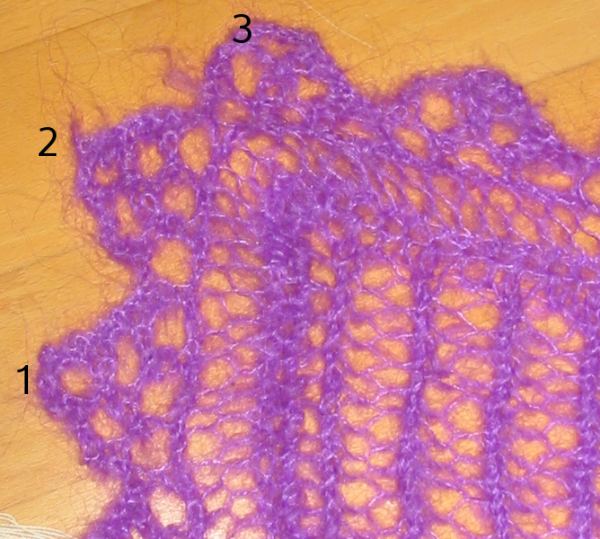
Die Anleitung gibt nur recht lapidar an, daß man zuerst „Corner A“, also „Ecke A“ stricken soll. Es ist auch ausführlich beschrieben, in welche (Rand)Maschen man beim Anstricken mehrfach strickt. Die Ecke geht über drei Rapporte des Bordürenmusters.

1.Rapport: 4 x einfache Verbindung (also eine Bordürenreihe in einer Masche verankern), 2 x doppelte Verbindung (zwei Bordürenreihen in einer Masche verankern)

2. Rapport: 1x doppelte Verbindung, 1x dreifache Verbindung (bis hierhin alles an den langen Rand des Schals) 1x doppelte Verbindung (ab hier jenseits der Ecke in die kurze Reihe des Schals gestrickt)

3. Rapport: 1x doppelte Verbindung, 5 x einfache Verbindung

Klingt gut und einfach.. ist aber für einen Rapport von 14 Reihen. Meine Randbordüre hat nur 12. 🙁

The instructions tell simply to knit „Corner A“. There are also charted instructions towards the end of the book how to distribute the joints, this uses three repeats of the border patter:

1. repeat: 4 single joints, 2 double joints

2.repeat: 1 double joint, 1 triple joint (up to here on the long side of the scarf), 1 double joint (the first knitted on the other side of the edge in the short side of the scarf)

3. repeat: 1 double joint, 5 single joints

Sounds precise and easy. Only it’s for a pattern with 14 rows, my pattern only has 12…

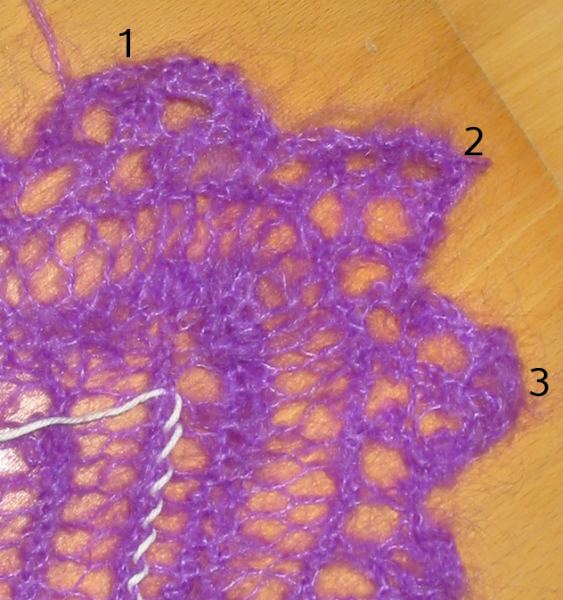
GestricktesIch habe es mit folgender Reihenfolge versucht:

Rapport 1: 2 einfache Verbindungen, 2 doppelte Verbindungen

Rapport 2: 3 doppelte Verbindungen

Rapport 3: 1 doppelte Verbindung, 4 einfache Verbindungen

So this us what I tried for Corner A:

Repeat 1:2 single joints, 2 douple joints,

Repeat 2: 3 double joints

Repeat 3: 1 double joint, 4 single joints.

Der Rand außen liegt so auch recht flach, aber (auf dem Bild sieht man das nicht so gut) da wo der Rand an den Schal angestrickt ist bildet sich eine hochstehende Blase.

The outer edge of the border seams to be laying nicely flat, but where it is knitted on (it’s not well to see on the picture) there is a „bubble“, it does not lay flat at all.

Gestricktes

Noch lustiger wird es dann bei der „Ecke B“. Hierfür gibt es gar keine Anleitung. Die Mehrfachverbindungen sind ja nicht symmetrisch auf beide Seiten verteilt, soll die Ecke B eher „gespiegel“ gestrickt werden, also wieder die meisten Maschen in die lange Seite, oder einfach wieder genauso, weil es egal ist, wie sich das um die Ecke verteilt?

Ich habe es so gemacht (etwas auch bedingt durch die Maschenzahl die noch übrig war):

Rapport 1: 1 einfache Verbindung, eine doppelte Verbindung, eine dreifache Verbindung.

Rapport 2: 3 doppelte Verbindungen, wobei ich ab der zweiten davon wieder in der langen Schalseite gearbeitet habe

Rapport 3: 1 doppelte Verbindung, 4 einfache Verbindungen

Das Problem ist das gleiche, eine hochstehende Blase. 🙁

„Corner B“ is even more fun, because there is no explanation at all. The joints are not symmetrical distributed to the long and the short side of the scarf, so how is „Corner B“ supposed to be done? Mirrored? Or not because it just doen’t make a difference?

What I did (also due to the number of stitches that remained in my short side) is:

Repeat 1: 1 single joint, 1 double joint, 1 triple joint

Repeat 2: 3 double joints (with the 2nd double joint on the long side of the scarf)

Repeat 3: 1 double joint, 4 single joints

Same problem: ugly „bubble“ 🙁

Nun, für diesen Schal ist es egal. Das Garn („kid light“ von Schachenmayr) war eine liebe Spende und lila steht mir nicht wirklich, ich hatte also eh nie vor, ihn zu tragen. (Und weiß jemanden, der das trotz der Fehler die drin sind gerne tun wird.) Gespannt habe ich noch nicht (es fehlen auch noch zwei Ecken), aber das Garn besteht zu 30% aus Mohair, der Rest sind diverse Polyfasern, da wird spannen nicht viel ändern.

Aber.. für mein nächstes Werk warten hier schon vier appetitliche Knäuel Rowan kidsilk haze von Daniela und die möchte ich nur sehr ungern versauen… :/

Deswegen, bitte, bitte, falls jemand hier mitliest, der schon mal so einen Schal gestrickt hat, vielleicht sogar aus dem Buch (und der Schal ist als „einfach“ ausgewiesen…) oder generell Erfahrung mit solchen angestrickten Rändern hat… bitte sagt mir, was ich entweder anders machen muß oder ob sich das mit kidsilk haze beim Spannen grade zieht?

Hilfe!

Well for this scarf I don’t mind. The yarn („kid light“ from Schachenmayr) was a kind gift and the colour isn’t right for me, so I never intended to wear it. (And I know someone who will wear it because of the colour and will not mind the mistakes that I made.) I didn’t block it yet, because there are two more corners to go, but the yarn is only 30% mohair fibre, the rest is „chemical“, so blocking will probably not change a lot.

But for my next shawl I already bought some oh so soft and light Rowan kidsilk haze from Daniela and I do not want to mess that up!

So, please, please, if someone is reading here who has experience with knitted on borders or with knitting from that book (the scarf was btw marked „easy“ lace…) I beg you, tell me how I can make it better! Or will everything be allright, once it’s knit with kidsilk haze and blocked?

Help!

Blaue Männerringel

SockenBlue stripes for men

Von meiner Sockenwollrestevernichtung profitiert auch mein Herzblatt.

Und alle blauen und ein paar graue Reste zusammen ergeben sehr bunte Socken. (Und wer sagt, daß Socken immer symmetrisch gemustert sein müssen? 😉 )

My plan to use up all my restover sockyarns fills not only my drawer, but also that of my sweetheart.

All blue and some grey yarns together make very coloured stripes. (Und who says, that socks need to have a symmetrical pattern? 😉 )

Schräg gerippt und quer geringelt

Zwei Reste ergeben ein Paar Socken. (Ja, Socken habe ich auch noch einige gestrickt und nie gezeigt. Aber ich versuche aufzuholen…)

Two yarnrestovers make one pair of socks. (Yes I also did some pair of socks and never showed them. But I’m trying to catch up…)

Restesocke
Diesmal weiß ich sogar noch, wo ich die Idee her habe, im Blog von Chopsewy, wo sie als Kiwisocken firmieren.

Bei Frau mhs habe ich dann noch einen kurzen Block auf eine vergleichbare Anleitung geworfen und dann war das Muster nicht schwer.

Die Ringel aus den beiden Garnen verlaufen quer, die Rippen schräg. Und der Vorteil von Tow Up ist, daß man nur ein bißchen was wieder auftrennen muß, wenn man bei der zweiten Socke merkt, daß von der einen Farbe weniger da ist als geplant, von der anderen dafür noch mehr…

This time I can even tell where I picked the idea, it was from Chopsewys blog, where they are called Kiwisocken.

Frau mhs had a similar pattern and allowed me a look, then everything was clear.

The two different yarns form horizontal stripes, the ribs run diagonal. And the advantage of toe up socks is, that you only have to ravel some rows when you find at the end of the second sock, that you have less yarn of the one colour (and more of the other) than expected…

Ich bin (k)ein Oecher Wollweib/ I am (not) a „Oecher Wollweib“

Aber schön war der Nachmittag trotzdem.

Anne und ZauberpuffelDa ich heute ohnehin in Aachen gearbeitet habe und außerdem relativ zeitig fertig war, nutzte ich die Gelegenheit zum Treffen der Oecher Wollweiber in den „Wolltreffer“ zu gehen.

Ein gemütlicher Platz mit interessanten Büchern, schöner Wolle und sehr vielen Oecher Wollweibern. Wobei die gar nicht alle aus Aachen waren… Und wenn nicht jemand gegangen wäre, als ich gekommen bin, wäre das mit dem Sitzplatz fast schwierig gewesen. 😉

Leider habe ich vergessen zu fragen, ob ich die Bilder veröffentlichen darf, deswegen beschränke ich mich auf zwei die ich schon öfter geknipst habe und bei denen ich weiß, daß sie nichts dagegen haben.

Maybe I should start to explain, what „Oecher Wollweiber“ are…. Well, it’s a knitting group in Aachen. The word for „coming from Aachen“ in the local dialect is „oecher“, and a „Wollweib“ is a „woolwoman“. More or less. „Weib“ is a word for a female person that was a very common word in medieval times, today it still is used in some local dialects in the same sense, but can also have an old fashioned or also a negative touch. So you can choose what is meant here… 😉

But whatever… I was having fun. I was working in Aachen today anyhow and luckily I also was finished early enough in the afternoon to attend a meeting of the group. It’s taking place in the „Wolltreffer“, a knitting cafe with equally delicious coffee and yarn. And it was so full… I only found a place to sit down on the big table because someone had to leave…

I took some pictures, but I forgot to ask the permission to show them on the web. So I can show only one pic, of those two. I have published pics of them before, so I am sure they don’t mind.

SockeDafür gibt es ein Bild von meiner aktuellen Restesocke.

Gestartet bin ich heute morgen mit der Spitze und einem knapp halben Fußteil. Zwei Bahnfahrten und ein Stricktreffen später bin ich über die Ferse hinweg und beim Schaft angekommen.

(Die Socken bekommt übrigens mein Mann.)

But I have a picture of the „use up my restover wool“ socks I’m knitting at the moment.

I had done the toe and about half the foot yesterday, now I’m over the heel and working my way up.

(Those will be for my husband.)